Endoscopic Spine Surgery

Home » Endoscopic Spine Surgery
The spine plays a vital role in supporting the body, enabling movement, and protecting the spinal cord. Conditions such as slipped discs, spinal stenosis, sciatica, and nerve compression can cause persistent back pain, leg pain, numbness, and reduced mobility. Endoscopic Spine Surgery is a modern minimally invasive technique that allows surgeons to treat spinal disorders through small incisions, resulting in less tissue damage, reduced pain, and faster recovery.
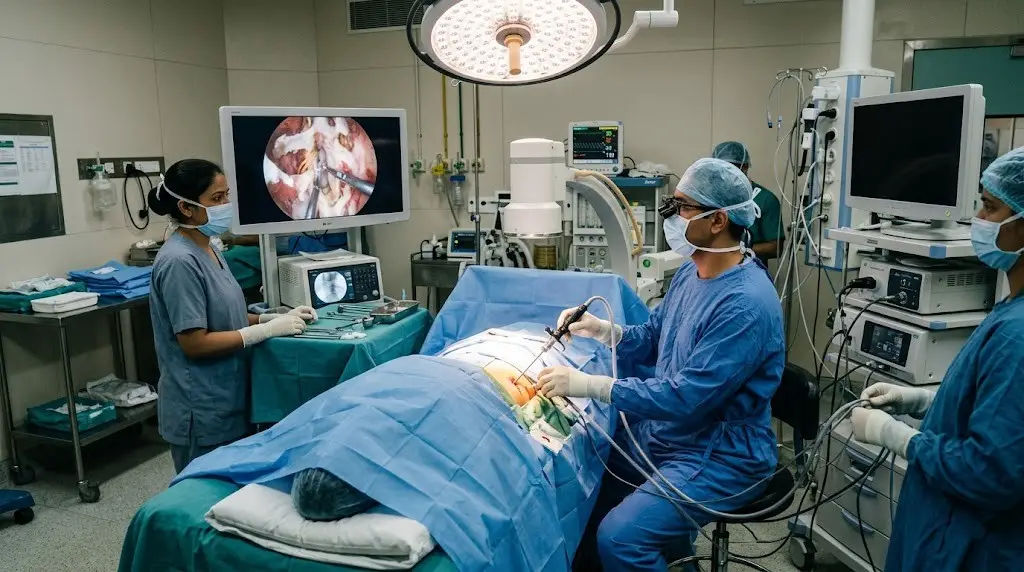
Surgeons perform an operation in an operating room, with a patient draped on the table and monitors nearby.
Dr. Atmaranjan Dash, one of the leading Neurosurgeons and Spine Specialists in Odisha, carefully evaluates each patient through clinical examination, MRI scans, X-rays, and other necessary investigations. Based on the diagnosis, he develops a personalized treatment plan focused on effective pain relief, spinal health, and a quicker return to daily activities.
Contact Us

🧠

FAQ Related To Endoscopic Spine Surgery

🧠
Get answers to common questions about endoscopic spine surgery, including eligibility, recovery, hospital stay, benefits, risks, and post-operative care. Dr. Atmaranjan Dash helps patients understand every step of their treatment journey with confidence and clarity.
Patients suffering from slipped discs, sciatica, spinal stenosis, nerve compression, and certain degenerative spine conditions may be suitable candidates. A detailed evaluation is necessary to determine the best treatment approach.
Since the procedure uses small incisions and causes minimal tissue disruption, most patients experience significantly less pain compared to traditional open spine surgery. Post-operative discomfort is usually manageable with medications.
Many patients can return home within 24 to 48 hours after surgery, depending on their condition and recovery progress. Some cases may even be performed as day-care procedures.
Benefits include smaller incisions, reduced blood loss, less post-operative pain, shorter hospital stays, faster recovery, and a quicker return to normal activities.
MRI scans, X-rays, blood tests, and other diagnostic investigations are commonly required to accurately identify the spinal condition and plan the procedure safely.
Recovery is generally faster than traditional spine surgery. Most patients can resume light activities within a few weeks, while complete recovery depends on the underlying condition and individual healing process.